
Forward-looking companies are spending real budget on visible sustainability.
A charging canopy in a busy lot—with the sponsor's name on it—is measurable exposure.
We broker that match:
the brand funds the hardware, your property hosts it,
and everyone shares the sustainability story.

⚡ DETROIT, MI • EST. 2024
INDEPENDENT EV STRATEGIST • LICENSED INSTALL PARTNER
Your parking lot may be an underused asset. Let’s find out how to maximize the profit from your parking lot.
I help commercial property owners decide whether EV charging makes sense and if it does, my partner electricians install it. No high-pressure pitch. No vendor kickbacks. Just a clean read on incentives, ROI, and what tenants actually want.
✓
Free 15-min consult
✓
72-hr feasibility memo
✓
Licensed install crew
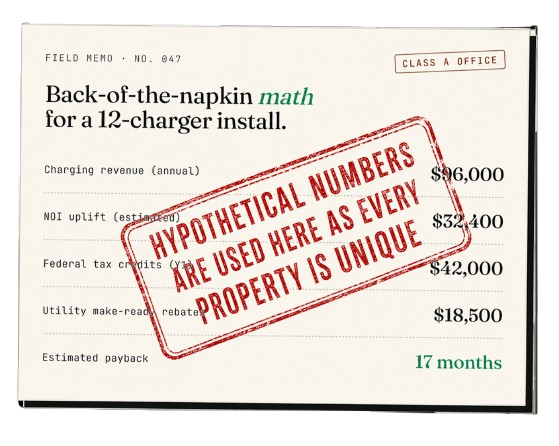
Every property is different. Revenue, costs, incentives, and payback periods vary based on electrical capacity, utility territory, charger type, parking dwell time, utilization, ownership structure, and permitting requirements. A site assessment is required before recommendations.
R1
IN PARTNERSHIP WITH BRANDS & INSTITUTIONS INVESTING IN CLEAN MOBILITY
YOUR LOGO HERE →
 DETROIT PISTONS
 PARTNER LOGO
 PARTNER LOGO
THE PROCESS · 60 DAYS, GIVE OR TAKE
From asphalt
to asset class.
Three honest steps. No 47-page proposals, no “strategic alignment workshops.” I show up, walk your lot, run the numbers, and tell you what I'd do if it were my building.
01
Site walk & feasibility
I come to your property, photograph your electrical room, talk to your tenants if appropriate, and pull utility data. Within 72 hours you get a one-page memo: should you do this, and at what scale.
02
The financial model
If the numbers work, I build a property-specific model revenue scenarios, incentive stack, depreciation schedule, sensitivity tables. You see every assumption. You can argue with every line.
03
Install, with my partner crew
Partner electricians handle permits, utility coordination, trenching, and commissioning. Same crew on-site every day. I project-manage. Your tenants barely notice.
WHAT WE BUILD AND WHO HELPS PAY FOR IT
Built to be seen.
Funded by brands.
Level 2 charging is the workhorse we install at most properties. Corporate sponsorship is how a growing number of those builds get paid for a brand underwrites the infrastructure in exchange for high-visibility placement, and the property owner gets the asset for a fraction of the cost.
LEVEL 02 • 240V AC
The workhorse.
WHAT WE
INSTALL
INSTALL
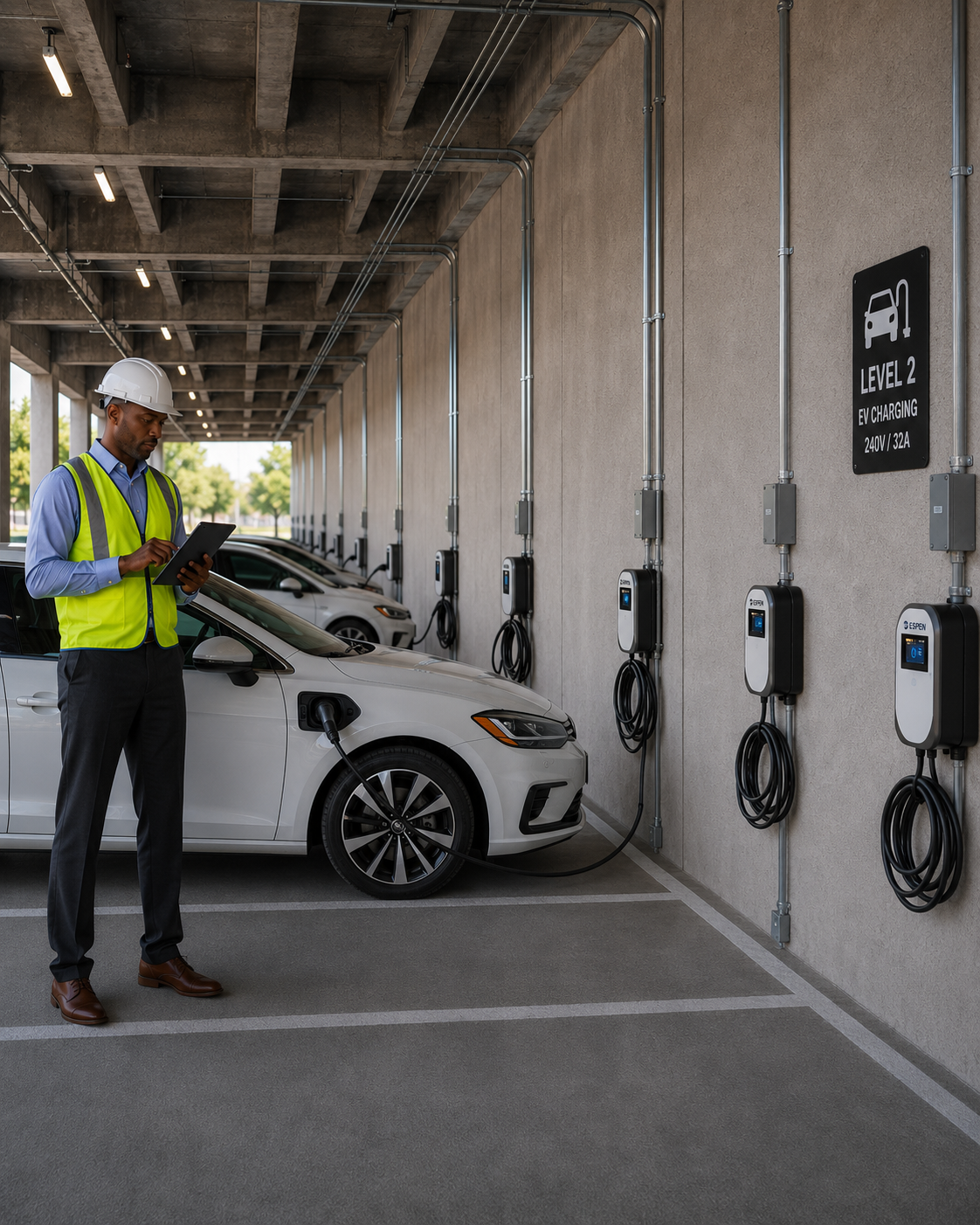
Affordable to install, reliable, ideal where cars sit for 4–10 hours.
INSTALL COST / PORT
$3K–$10K
REVENUE / PORT
Site-dependent
TRAFFIC • PRICING • DWELL TIMEBEST FIT
- Office buildings (8-hour parking)
- Multifamily & long-stay residential lots
- Strip malls with anchor retail
- Event & performance venues
- Properties without high-amp service
CHARGE RATE
19–25 mi/hr
PAYBACK
Site-specific
SERVICE
40A typ.
CORPORATE SPONSORSHIP
The headline maker.
BRAND
FUNDED
FUNDED
A brand underwrites the build. You get the infrastructure for a fraction of the cost.
WHAT A SPONSOR BRINGS
- Capital that offsets install cost
- Co-branded canopies & signage
- ESG reporting they can publish
- Long-term sustainability exposure
OWNER CAPITAL OUTLAY
Explore a sponsored build →
As low as $0
A note from JR
Most properties are best served by Level 2 the paybacks are usually adequate and the install is far more affordable. The real unlock is pairing that with a corporate sponsor: the brand funds the build, you get the infrastructure, and everybody gets the sustainability story. Start with how long cars sit then we'll find the brand that wants to be parked next to them.
The premium build · solar canopies + battery storage
Charge from the sun.
Store it. Sell it back.
The flagship sponsored build: solar awnings over your Level 2 chargers turn empty parking into a clean-power plant. A well-placed battery banks the excess — then powers the lot at night, shaves your demand charges, or sells energy back to the grid when prices spike. It's the kind of visible, measurable infrastructure brands love to put their name on.

01 - SOLAR CANOPIES
Steel awnings carry the PV array and shade the cars beneath. Generation offsets the charging load — and the structure itself becomes premium sponsor signage real estate.
02 - BATTERY STORAGE
A well-placed battery bank stores midday surplus, powers the lot after dark, and reduces demand charges that quietly inflate commercial utility bills.
03 - SELL BACK TO GRID
When utility rates spike, stored energy can flow back to the grid for credit — transforming your parking lot into a revenue-generating power asset.
ENERGY FLOW • SCHEMATIC A.07
SUNLIGHT
Illustrative system diagram — actual array, storage, and interconnect sized
per site during the feasibility memo.
THE REVENUE MODEL · STACKED, NOT SINGLE
How EV Charging Can Support Property Performance.
The financial case isn't built on a single revenue line it stacks. Charging fees alone usually don't justify the spend. Charging fees plus NOI uplift plus tax credits plus utility rebates plus depreciation plus tenant retention? Different conversation.
01 / Planning
Value
PROPERTY SPECIFIC
Additional Revenue Potential
EV charging may create an additional revenue stream for some properties. Actual outcomes depend on utilization, charger type, pricing strategy, electrical capacity, and local demand.
02 / Income
+
LONG-TERM PERFORMANCE
Income Contribution
Depending on usage patterns and operating costs, EV charging may contribute to property income and support long-term asset goals.
03 / Experience
EV
TENANT AMENITY
Tenant Convenience
Charging access can improve convenience for tenants, employees, visitors, and customers as EV adoption continues to grow.
04 / Incentives
✓
PROGRAMS MAY APPLY
Incentive Opportunities
Utility programs, grants, and tax incentives may help reduce project costs where available and eligibility requirements are met.
05 / Strategy
Plan
SITE SPECIFIC
Financial Planning
Project economics vary based on installation costs, utilization, utility rates, maintenance expenses, and available incentives.
06 / Future
EV+
LONG-TERM FLEXIBILITY
Future-Ready Infrastructure
EV charging can be deployed in phases, allowing property owners to evaluate demand and expand as conditions warrant.
Important: The information above is provided for planning purposes only and should not be interpreted as a revenue projection, financial guarantee, investment advice, or promise of results. Actual outcomes vary based on electrical capacity, utility rates, charger type, utilization, installation costs, incentive availability, ownership structure, permitting requirements, and site-specific conditions.
Incentive stacking · this is the part most owners leave on the table
Available Incentives May Help Reduce Project Costs.
Federal, state, and utility incentives can offset 40–70% of installation cost. The hard part isn't qualifying it's knowing what to apply for, in what order, before windows close. Here's a working summary as of Q2 2026.
IRA Section 30C Credit
Applies to commercial charging equipment. Bonus credits available in low-income & non-urban census tracts.
Benefit
Up to 30% of equipment cost
Maximum
$100K per location
Window
● Through 2032
Michigan Charge Up Program
State-administered funds for commercial EV infrastructure. Matching grants available for qualified properties.
Benefit
Facility grants + rebates
Maximum
$70K / project
Window
● Open · annual
DTE / Consumers Make-Ready Programs
Utility programs covering transformer upgrades and distribution infrastructure costs.
Benefit
Grid upgrade coverage
Maximum
$5K–$75K
Window
● Program-dependent
MACRS Bonus Depreciation
Accelerated depreciation schedule creating meaningful Year-1 tax shield benefits.
Benefit
Immediate tax basis reduction
Maximum
40% in 2026
Window
● Steps down annually
EPA Clean Air Grants
Grant opportunities for eligible commercial properties and air-quality improvement projects.
Benefit
Direct grant funding
Maximum
Varies by program
Window
● Ongoing
TENANT SIGNAL · 2025–2026 lEASING DATA
Tenants are choosing
EV-ready buildings.
EV charging has crossed the threshold from amenity to expectation. Properties that don't offer it are increasingly at a competitive disadvantage particularly for Class A office and premium retail tenants in the Detroit metro market.
If you've lost a tenant in the last 18 months and EV charging came up in the conversation, you already have your data.
Corporate tenants ranking EV charging as a "must-have" amenity in lease renewals
0%Premium tenants willing to pay higher rent for EV-ready buildings
0%Reduction in tenant turnover at properties with EV charging
0%Increase in EV registrations in Michigan since 2020
0%QUICK MATH · ADJUST TO YOUR PROPERTY
Scenario Builder.
This is a rough planning tool, not a quote or guarantee. Actual results depend on installation cost, utility rates, charger type, utilization, pricing, maintenance, network fees, and incentive eligibility.
TOTAL PARKING SPACES
120
10
500
EV CHARGER COVERAGE
15% (18 ch.)
0%
50%
AVERAGE REVENUE PER CHARGER
$11K
$0
$22K (Premium)
PROPERTY TYPE
Class A Office
Year-one estimate
CHARGING REVENUE
$198,000
NOI UPLIFT (EST.)
$69,300
FEDERAL TAX CREDIT
$54,000
UTILITY & STATE REBATES
$27,000
YEAR-1 TOTAL VALUE
$348,300
Estimates based on average utilization rates and prevailing incentives in the Detroit metro market. Actual results vary by site and tenant mix.
CASE FILES · REPRESENTATIVES INSTALLS , REAL PROPERTIES
Example Project Scenarios.
Illustrative examples only. Actual project outcomes vary and should be confirmed through site assessment and contractor pricing.
Class A office tower
DETROIT
RENAISSANCE CTR.
RENAISSANCE CTR.
$198K
ANNUAL REVENUE
5.2%
NOI UPLIFT
16 mo
PAYBACK
“We expected a modest amenity. What we got was a new income line item and a 5-year lease renewal from our anchor tenant.”
Mixed-use retail
ROYAL OAK
MAIN STREET
MAIN STREET
$124K
ANNUAL REVENUE
4.7%
NOI UPLIFT
22 mo
PAYBACK
“The dwell time data alone was worth it. EV drivers stay 47 minutes longer on average.”
Surface parking garage
ANN ARBOR
DOWNTOWN
DOWNTOWN
$312K
ANNUAL REVENUE
N/A
PARKING ASSET
19 mo
PAYBACK
“Utilization on EV-designated spaces runs at 89%. We've put a waitlist on charging subscriptions.”
ABOUT · THE HUMAN BEHIND THE SPREADSHEET
My work is rooted in a deep respect for Planet Earth for the delicate, extraordinary atmosphere that gives us life, protects us, and connects every community we serve.
I believe progress requires both innovation and accountability: building systems that move people forward while being responsible stewards of the environment we all depend on. Through this mission, I’m working to create high-visibility EV charging destinations that combine clean mobility, renewable energy, thoughtful design, and long-term community value.
By bringing in aligned corporate sponsors, my goal is to give companies a meaningful way to support the transition to cleaner transportation while using their platforms, resources, and visibility to help accelerate real-world infrastructure change.
This is not just about charging vehicles. It is about building places that reflect where the future is headed cleaner, smarter, more responsible, and more connected to the planet that makes all life possible.
JR Anderson
INSTALL PARTNER
Detroit Voltage
• 3rd-generation Detroit electricians
HONEST ANSWERS TO THE QUESTIONS YOU’S ASK IN PRIVATE
Everything you
were afraid to ask.
-
The first 15 minutes is free I'll tell you on the phone whether it's worth a site walk. The site walk and feasibility memo is also free. If we move to a full financial model and project plan, I charge a flat $4,500. That's it. No commissions, no kickbacks, no markup on equipment.
-
Because I'm not selling you chargers. National charging companies make money on every kWh sold and every install completed they're structurally biased toward saying yes and going big. I make money on assessments and project management. About a third of my recommendations are “not yet” or “not at this property.” That's my pitch.
-
Four to eight weeks for most properties from contract signature to commissioning. The variable is utility coordination DTE turnaround on service upgrades is typically 3–6 weeks. We submit early in the process so it runs in parallel with permitting.
-
It's a fair question. The financial model I build for you stress-tests three scenarios: aggressive adoption, base case, and a 50%-haircut case where adoption flatlines for five years. If the project doesn't pencil under the haircut case, I'll tell you not to do it. Most don't pass that test for free-standing retail. Most office and multifamily do.
-
Most of my work is metro Detroit, Toledo, and southwest Ontario. I've consulted on projects in Chicago and Cleveland. I won't take on a property I can't drive to in a day site walks are too important to do remotely.
-
The site walk catches most of these before they become surprises. If we find something during install undersized service, code violations in the existing panel Tousignant pauses, scopes the fix, and gives you a written change order before any extra work begins. No surprise invoices. Ever.
GET IN TOUCH · I READ EVERY EMAIL MYSELF
Start with a free fit call.
A licensed engineer and commercial EV strategist will assess your property and deliver a customized financial model at a minimum cost.
A free 15-minute fit call helps determine whether EV charging may be a good fit for your property. For qualified properties, the next step is a paid site assessment followed by a feasibility memo, project recommendations, financial modeling, and installation coordination if moving forward. Every property is different. Recommendations are based on site conditions, utility requirements, project costs, and expected usage.
☎
810-339-0128
✉
info@carsense.pro
⌖
Detroit, Michigan